The challenges of manual processes in water testing labs
By Roxana Florea·
In short
Manual processes are steps where people copy, type or track lab data by hand: paper chain of custody forms, results typed into a spreadsheet, hold times on a whiteboard. They slow a water lab and let errors in. In one study of hand-typed clinic results, 3.7% did not match what the device sent (Mays and Mathias, 2019). It shows most in tight hold times, the records the rules ask for, and reports to the state or EPA.
On a Monday morning, the private-well kits, the plant’s wastewater composites and a water system’s coliform bottles all land at one receiving desk, each with its own paper form. Water testing labs check public water, private wells and wastewater, and many still run part of the day on paper and spreadsheets.
What counts as a manual process in a water lab?
A manual process is any step where a person moves data by hand instead of a system doing it. In a water lab, that often looks like this:
- Sample details go on a paper chain of custody form, then get typed in again at login.
- Results are copied from an instrument printout into a spreadsheet.
- Hold times are tracked on a whiteboard or a calendar.
- Each report is built by hand in Word or Excel.
- Results are typed a second time into a state portal or a permit report.
Labs we talk to often describe the same result typed two or three times before it reaches a report. Each step is small, but each one is a chance to copy something wrong, and the steps add up over a week. Our post on when to move past Excel and Word lists the signs that a lab has outgrown them.
Why does manual data entry cause errors?
People make typing mistakes, even careful and experienced people. A 2019 study in the Journal of the American Medical Informatics Association compared 6,930 test results that staff typed by hand with the same results sent straight from the device. In 260 of them (3.7%), the two did not match (Mays and Mathias, 2019). The authors put the rate of errors that mattered for patient care at about 5 in 1,000.
That study took place in clinics, not in a water lab, but the task is the same: a person reads a number and types it. In a water lab, for example, one wrong digit in a lead or nitrate result could change what a water system or a family is told.
How do manual processes slow a lab down?
A hold time is the longest a sample may wait between collection and analysis. Under the Clean Water Act rules, the hold time for a grab sample “begins at the time of collection” (40 CFR 136.3, Table II, footnote 4). For coliform and E. coli tests, the same rule lists a hold time of 8 hours.
With paper and spreadsheets, nobody sees the clock for every sample at once, so a sample that waits while its form is typed in can run out of time, and then it may have to be collected again. Retyping data, chasing missing forms and checking reports by hand also take staff time away from testing. See how sample holding times work.
How does manual work hurt each kind of testing?
Public water systems
EPA counts more than 148,000 public water systems in the United States (EPA). The rules say what their test records must show. Under 40 CFR 141.33, a water system keeps records of microbiological analyses for at least 5 years and of chemical analyses for at least 10 years (40 CFR 141.33). Each record shows when, where and by whom the sample was collected, the lab, the method and the results. For the rules that changed this work most, read how EPA rules changed water testing labs from 2012 to 2022.
A record is only as good as the data behind it, and a detail missed on a paper form is hard to fix years later. If your state takes results through EPA’s Compliance Monitoring Data Portal, read our post on CMDP reporting.
Private wells
Private wells work differently. EPA says private wells are not regulated under the Safe Drinking Water Act, and that well owners are responsible for safe drinking water in their homes. EPA estimates that more than 23 million US households rely on private wells (EPA).
For a lab, that often means many small, one-time customers, and each family needs a sample kit, a form, a result and a clear letter. Done by hand, intake and reporting for hundreds of single samples can take a lot of staff time. A typo in a name or an address could send a result to the wrong home.
Wastewater
A Discharge Monitoring Report (DMR) is the report a permit holder sends with its wastewater results. EPA’s NPDES Electronic Reporting Rule, published on October 22, 2015, “replaces most paper-based NPDES reporting requirements with electronic reporting,” and DMRs are among the reports it covers (EPA).
When results live in a spreadsheet, someone has to type them into the report again, which adds one more copy step and one more place for a wrong digit or a wrong unit. See what a wastewater lab needs from its LIMS, or read our guide to NetDMR and DMR reporting.
Which manual steps cause the most trouble?
| Manual step | What can go wrong | What helps |
|---|---|---|
| Paper chain of custody form | Details lost, or typed in wrong at login | Log each sample once, when it arrives |
| Results copied from printouts | A wrong digit or unit | Load the instrument’s results file |
| Hold times on a whiteboard | A sample runs past its hold time | A system that counts from collection |
| Reports built by hand | An old template or a missed result | Reports built from reviewed data |
| Retyping into a portal | Two versions of the same result | Files made from the same record |
What helps cut manual errors in a water lab?
- Enter data once. Log each sample when it arrives, and use that record for every later step, so nobody retypes it.
- Let the system watch the clock. A LIMS can count each sample’s hold time from collection and show which samples are close to the limit.
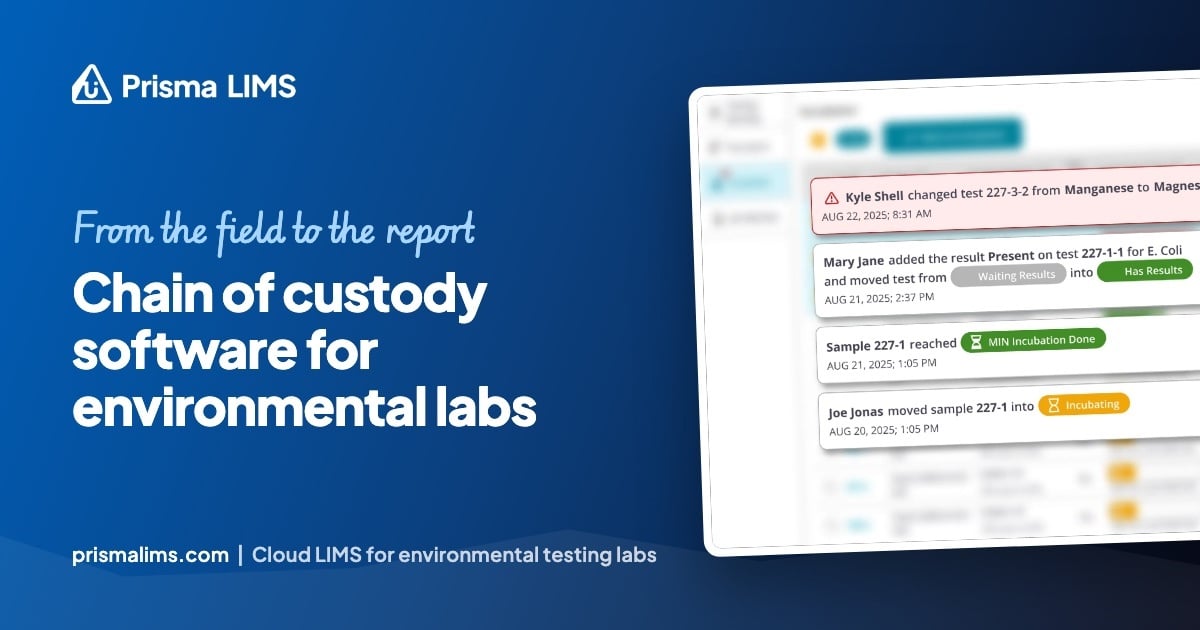
- Keep the hand-offs on record. Chain of custody is the record of who held each sample, and when. See what chain of custody software should record.
- Load results from files. Where an instrument can export a results file, load that file instead of retyping the numbers.
- Check before results go out. Have a second person review results, or let the system flag values outside the limits.
Each of these changes a habit, too. Our post on new lab technology and resistance to change covers how to bring a wary team on board.
Where does Prisma LIMS fit?
Prisma LIMS is a cloud LIMS for environmental testing labs in the US and Canada. We set it up for your lab, move your data, train your team, and run the hosting and support. Accreditation belongs to the lab. Prisma LIMS keeps chain of custody and a full audit trail of who changed what and when.
Comparing systems? Our environmental LIMS vendors table sets them side by side. We also have pages on the Confience myLIMS alternative, the Khemia Omega LIMS alternative and the ALPACA LIMS alternative for environmental labs.
Questions labs ask about manual processes
How common are manual data entry errors?
Studies differ, and most were done in clinical settings. One 2019 study of clinic test results found that 3.7% of hand-typed results did not match the result the device sent (Mays and Mathias). Your own rate depends on how often each number is copied, and by whom.
When does a sample’s hold time start?
Under 40 CFR 136.3, the hold time for a grab sample begins at the time of collection, not when the sample reaches the lab. For a composite sample from an automated sampler, it begins at the end of collection (40 CFR 136.3).
Do private wells follow the same rules as public water?
No. EPA says private wells are not regulated under the Safe Drinking Water Act. Well owners are responsible for safe drinking water in their homes.
Looking at LIMS options for your lab? See how Prisma LIMS works as an environmental LIMS for water, wastewater and soil labs.
Sources (6)
We read each page below on 26 November 2026 and checked every claim in this post against it. Rules change, so check the current text before you act on it.
- Mays JA, Mathias PC. Measuring the rate of manual transcription error in outpatient point-of-care testing. JAMIA, 2019 (checked 26 November 2026). pmc.ncbi.nlm.nih.gov
- 40 CFR 136.3: Identification of test procedures (Table II and footnote 4) (checked 26 November 2026). law.cornell.edu
- EPA: Information about public water systems (checked 26 November 2026). epa.gov
- 40 CFR 141.33: Record maintenance (checked 26 November 2026). law.cornell.edu
- EPA: Private drinking water wells (checked 26 November 2026). epa.gov
- EPA: NPDES eReporting (checked 26 November 2026). epa.gov