What is a LIMS? A guide for environmental labs
By Roxana Florea·
In short
LIMS stands for laboratory information management system. A LIMS is software that tracks each sample in a lab, from the moment it arrives to the final report. It keeps the sample’s tests, results, quality control (QC) and reports in one place. An environmental lab also uses it to watch hold times, keep chain of custody and send results to its clients and the state.
Most people meet the word LIMS the week a lab outgrows its spreadsheets: a client asks for an EDD, an assessor asks who changed a result, or two analysts need the same workbook at the same time. A LIMS is the software built for those moments, from a sample’s login to its report.
What does LIMS stand for?
LIMS stands for laboratory information management system.
CDC’s lab training defines it this way: a LIMS helps a lab “track and manage the workflow of a specimen and its associated data throughout the laboratory, from the time a specimen is received through the reporting of results” (CDC).
ASTM E1578, the standard guide for lab software, puts the LIMS in a wider group it calls laboratory informatics. That group also holds the ELN, the LIS, the SDMS and the chromatography data system (CDS) (ASTM E1578).
What does a LIMS do?
A LIMS follows one sample from login to report. Here is that path in a typical environmental lab:
- At login, each sample gets a unique lab ID when it is received. MARLAP, a lab manual from EPA and other agencies, says each sample should get an ID “by which it can be logged into the LIMS, scheduled for analysis, tracked, and disposed” (EPA MARLAP).
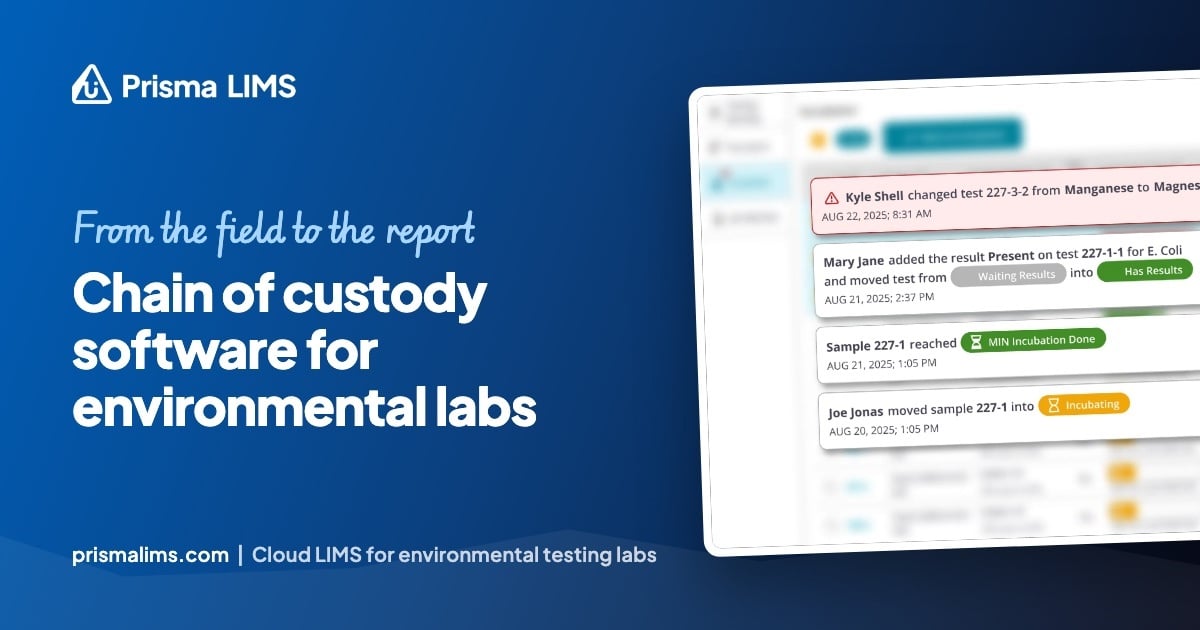
- For chain of custody, the LIMS records who collected, handed over and received each sample, and when. See chain of custody software for environmental labs.
- It schedules the tests for each sample and shows how long each one can wait (the hold time).
- It groups samples into prep and analysis batches with their QC samples, such as blanks and spikes.
- Analysts enter results or import the files their instruments export.
- A second person reviews and approves the data before it goes out.
- Last, the LIMS builds the client report and any data files, such as an EDD (electronic data deliverable) or a state upload.
Every step leaves a record. That is the real point of a LIMS: you can show who did what, and when, for any sample.
How is a LIMS different from an ELN, LIS or QMS?
A LIMS keeps samples, tests, results, QC, chain of custody and reports. An ELN (electronic lab notebook) keeps notes on experiments, in place of a paper notebook. An LIS (laboratory information system) keeps patient test orders and results for clinical labs. A QMS keeps SOPs, training records, audits and corrective actions. An SDMS keeps raw instrument files. An environmental testing lab mostly needs a LIMS.
| System | What it keeps | Who uses it most |
|---|---|---|
| LIMS (laboratory information management system) | Samples, tests, results, QC, chain of custody and reports | Testing labs that run many samples: commercial, municipal, utility and government labs that test water, wastewater, soil and more |
| ELN (electronic lab notebook) | Notes on experiments, in place of a paper notebook | Research and development labs |
| LIS (laboratory information system) | Patient test orders and results | Clinical labs. CDC notes that a clinical LIMS is sometimes called an LIS |
| QMS (quality management system) | SOPs, training records, audits and corrective actions | Quality managers in any lab |
| SDMS (scientific data management system) | Raw data files from instruments | Labs with many instruments |
An environmental testing lab mostly needs a LIMS. It rarely needs an LIS, which is built for patients, not for water or soil samples.
Who needs a LIMS?
Rules say what a lab must record. They don’t name the software. A small lab can keep good records on paper. But as the work grows, these signs show up:
- Staff copy the same data between paper, spreadsheets and email.
- Someone has to hunt for a sample’s status or its chain of custody form.
- Hold times are watched by memory or by a wall chart.
- Audits take days of pulling records together.
- Clients and the state each want results in their own file layout.
If several of these sound familiar, read when a water lab should move past Excel and Word.
What makes an environmental LIMS different?
An environmental lab tests water, wastewater, soil and sludge for permits, cleanups and public health. That work has rules a general LIMS may not handle well:
- Hold times come first. Many tests have a deadline that starts at collection. For a coliform sample under the Clean Water Act, it is 8 hours (40 CFR 136.3, Table II). See sample holding times.
- Results often end up in legal or permit files, so every hand-off in the chain of custody must be on record.
- One test can cover many sample types: the same metal test may run on drinking water, wastewater and soil, each with its own limits and units.
- Methods set the batch QC: the blanks, spikes and duplicates that each batch needs.
- Labs send results to states and clients as data files. EPA’s data file for its contract labs, SEDD, is “created by a laboratory’s Laboratory Information Management System (LIMS)” (EPA). See our guide to EDD formats.
For the full list, read what an environmental LIMS must handle.
Should a LIMS run in the cloud or on your own server?
A LIMS can run on your own server (on-premise) or in the cloud, where the provider runs the servers and you usually sign in through a web browser. On-premise gives you full control, but your team handles the hardware, updates and backups. Check who handles updates and backups.
Read what a cloud LIMS is, or compare both in cloud LIMS vs on-premise LIMS.
Where does Prisma LIMS fit?
Prisma LIMS is a cloud LIMS for environmental testing labs in the US and Canada. We set it up for your lab, move your data, train your team, and run the hosting and support.
Questions people ask about LIMS
What is a LIMS in simple words?
LIMS meaning, in simple words: it is the software a lab uses to keep track of its samples. It records each sample when it arrives, the tests it needs, the results, who checked them and the report that goes out. So anyone in the lab can see where a sample is and what happened to it.
What is a LIMS used for?
A lab uses a LIMS to run its daily sample work in one place. It logs samples in, keeps chain of custody, plans tests and batches, records results and QC, and builds reports and data files. In an environmental lab, it also helps staff watch hold times, so a sample is tested before its time runs out.
Is a LIMS the same as an LIS?
Not quite. LIS usually means software for clinical labs that test patient samples, and CDC notes that a clinical LIMS is sometimes called an LIS. A LIMS is used by testing labs such as environmental and water labs, where the sample is water, soil or sludge, not a patient.
Is a LIMS the same as a database or a spreadsheet?
A LIMS keeps its data in a database, but it adds the lab’s steps on top: login, chain of custody, batches, review and reports. A spreadsheet holds numbers, but it does not keep a record of who changed what, and when. As a lab grows, that missing record is often what makes audits slow.
How much does a LIMS cost?
It depends on setup, hosting, support and how the vendor counts users. An on-premise LIMS also brings server, upgrade and IT staff costs. A cloud LIMS usually has a setup cost and then a regular fee. Our guide to LIMS cost and total cost of ownership lists what to add up over several years.
Looking at LIMS options for your lab? See how Prisma LIMS works as an environmental LIMS for water, wastewater and soil labs. Want to know what a sample’s custody record must show? Read what a chain of custody form records.
Sources (5)
We read each page below on 26 November 2026 and checked every claim in this post against it.
- ASTM E1578-18: Standard Guide for Laboratory Informatics (scope) (checked 26 November 2026). astm.org
- CDC: Introduction to Laboratory Informatics, “What is a LIMS?” (transcript) (checked 26 November 2026). reach.cdc.gov
- EPA: MARLAP Chapter 11, Sample receipt, inspection and tracking (July 2004) (checked 26 November 2026). epa.gov
- 40 CFR 136.3, Table II: Required containers, preservation techniques, and holding times (checked 26 November 2026). law.cornell.edu
- EPA: Staged Electronic Data Deliverable (SEDD) (checked 26 November 2026). epa.gov