
Chain of custody software for environmental labs
An environmental chain of custody follows a sample from the bottle order to the final report. A cooler reaches receiving at 4:40 on a Friday. The COC inside is damp, and the sampler signed it but left the time blank. This guide shows what the record must hold, where paper forms break, and what to ask any software vendor.
In short
Chain of custody software records every hand-off of a sample, from the bottle order to the final report. It shows who had the sample, when, where and in what condition. For an environmental lab, that record is what lets a result stand when a client, a regulator or an auditor asks. Prisma LIMS, a cloud LIMS built only for environmental labs, keeps chain of custody and a full audit trail of who changed what and when.
Why a broken chain of custody costs a sample
A sample with a gap in its record can’t be used. The cooler sat on a dock and nobody signed for it. The time of receipt is blank. The result may be right, but nobody can prove it.
Then the client pays to sample again. Some samples can’t be taken again at all: the storm has passed, or the spill is cleaned up. Either way, the report is late.
And the client remembers which lab lost the sample. A clean chain of custody costs a few signatures. A broken one costs a field trip, a late report and some trust.
What chain of custody software must capture
EPA covers this in its Contract Laboratory Program Guidance for Field Samplers (October 2014), section 4.3, where the form is a combined Traffic Report and chain of custody record (TR/COC). In EPA’s words, a chain of custody record “documents the exchange and transportation of samples from the field to the laboratory.”
The software must capture the same facts as the form. For a field-by-field read of the paper form, see what a chain of custody form records. In short, here is what it must hold.
- The sampler’s name and signature show who collected it.
- The site and the sample point show where it came from.
- The date and time of collection show when. The hold-time clock starts here: 8 hours for coliform and 48 hours for BOD under 40 CFR 136.3, Table II.
- Sample IDs, the matrix and the tests asked for show what the client wants done.
- The bottle types, how many came in, and the preservative in each show how it was kept.
- At receipt, the record notes the temperature, whether it came on ice, and whether the seals were intact. Many Clean Water Act tests, such as TSS and ammonia, call for samples cooled to 6 °C or below (40 CFR 136.3, Table II).
- Every hand-off shows who gave the samples up, who took them, and the date and time.
EPA’s guide covers each hand-off too. The record “must be signed off by the former custodian and accepted by the new custodian”. See how a LIMS tracks sample holding times.
Inside the lab, custody goes on. EPA’s SW-846 Chapter One (Revision 2, July 2014) lists sample custody among a lab’s written procedures: receipt and handling, storage, security and tracking, and holding times.
Paper COC vs electronic chain of custody
An electronic chain of custody keeps the same facts as the paper form. The difference is what happens to them next.
| Step | Paper COC | Electronic COC |
|---|---|---|
| Signing | Ink on a form that travels in the cooler. | Each person signs in with their own login. |
| Dates and times | Written by hand, sometimes missed. | Stamped by the system at each step. |
| Getting it into the LIMS | Someone retypes it at login. | It is already there. Nobody retypes it. |
| Changes | A line through the old value, if you are lucky. | The old value, the new value, who and when. |
| Finding it later | A scan or a box in storage. | A search by sample, client or date. |
Where paper COCs go wrong
- A missing signature at one hand-off breaks the whole chain.
- With a time nobody can read, or no time at all, the hold time can’t be checked.
- The sample IDs on the form don’t match the bottle labels.
- Someone retypes the form into the LIMS, and every field typed twice is one more chance for a typo.
- The form ends up wet, torn or lost at the bottom of the cooler.
How chain of custody works, hand-off by hand-off
Six steps take a sample from the bottle order to the report. At each one, something gets recorded by someone. Labs we talk to often say the trouble starts before the sample arrives, with bottle orders and courier pickups.
Bottle order
The lab sends the right bottles, preservatives and a COC for the tests ordered. When the right bottle goes out, fewer samples get turned away at receipt.
Sampling
The sampler records the sample ID, place, date and time, then signs to give up the cooler. The collection time starts the hold-time clock. Some tests have two: pesticides and PAHs in water must be extracted within 7 days, then analyzed within 40 days (40 CFR 136.3).
Receipt at the lab
The sample custodian checks the seals, the temperature and the bottles against the form. Then they sign and record the time.
Login and labels
With pre-login, the lab expects the samples before they arrive. Login ties each bottle to its tests and prints a barcode label once. Nobody retypes the ID after that.
Bench hand-offs
Each move from storage to prep to the instrument is a hand-off. The LIMS records who took the sample and when.
Report
The final report goes out with its chain of custody. The client can see the full trail behind each result.
What to ask any chain of custody software vendor
Ask to see each answer on your own samples and your own COC form, not on a slide.
How Prisma LIMS keeps chain of custody
Accreditation belongs to the lab. Prisma LIMS keeps chain of custody and a full audit trail of who changed what and when.
Prisma LIMS starts each sample’s hold-time clock at the collection time, shows the time left and warns you before it runs out. One sample can carry two clocks: one to extraction and one to analysis.
With Prisma LIMS you get a full audit trail, and an API for your team. Clients can view results in a read-only portal.
Done-for-you means we do the work: we map your workflow, set up your methods and reports, move your data, test it with you in a sandbox, train your team on-site, and stay with you through go-live. See how you get live on Prisma LIMS.
Ask us to show the audit trail on your own samples and files.
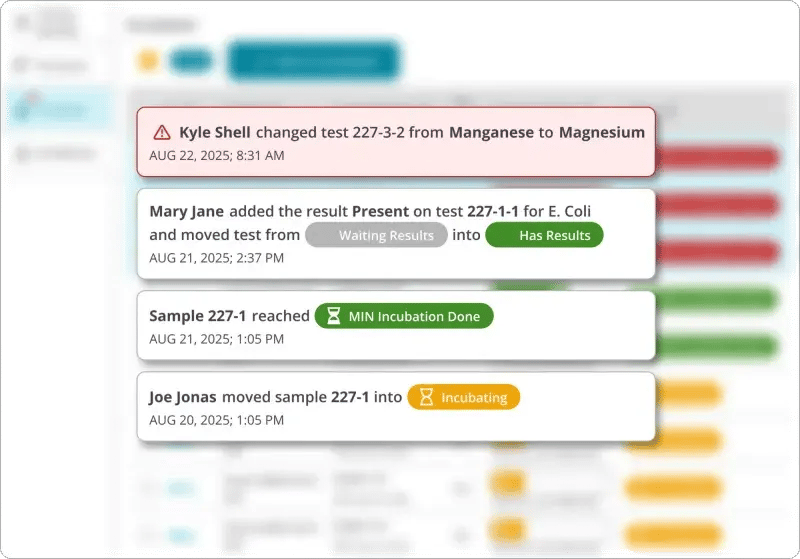
Every sample traced from the field to the report
When every hand-off is on record, a result holds up when a client, a regulator or an auditor asks. Your team spends less time hunting for signatures, and fewer samples have to be taken again.
Built for
Prisma LIMS is built only for environmental labs: mid-sized and large commercial, municipal and utility labs that test water, wastewater, drinking water, soil and sludge, in the US and Canada. Other environmental matrices are on request.
Methods running on Prisma LIMS today: EPA 524, 525 and 552, and THMs; EPA 200.7 and 200.8, and SW-846 6010 and 6020; total coliform and E. coli; BOD and TSS.
Not a fit for
Prisma LIMS is not a fit for clinical-only or pharma-only labs, very small labs, or labs that prefer to build and run their own system.
Questions people ask
What is a chain of custody?
In an environmental lab, a chain of custody is the signed record of every hand-off of a sample: who had it, when, where and in what condition, from collection to the report. EPA calls it the record that “documents the exchange and transportation of samples from the field to the laboratory”.
How does chain of custody work?
Each person who hands a sample on signs it over. The next person signs to accept it, with the date and time. It starts when the sample is collected and ends with the final report. A gap anywhere means nobody can prove what happened to the sample.
What must chain of custody software record?
It records who collected the sample, where and when, and the sample IDs and tests. It also keeps the bottles, the preservatives and every hand-off, with a name, date and time, plus the temperature and the seals at receipt. For the paper form, field by field, see what a chain of custody form records.
What is an electronic chain of custody?
An electronic chain of custody keeps the same facts as the paper form, inside software. Each person signs in with their own login, the system stamps the time, and nobody retypes the form at login.
Paper or electronic chain of custody: which is better?
Electronic is easier to keep complete, because the system can stop a hand-off with no name or no time. Paper still works when the field crew has no signal. Many labs use both: paper in the field, then electronic from receipt on.
What is the best chain of custody software for environmental labs?
The best one records every hand-off with a name, date and time, from the bottle order to the report, and stops a hand-off with no name or time. Ask any vendor to show it on your own COC form. For what Prisma LIMS records, see how Prisma LIMS keeps chain of custody.
Keep reading
-
Environmental LIMS guide
A wrong choice costs years. This guide lists what to check in any system. It ends with the questions to ask every vendor.
Environmental LIMS: how to compare systems -
Sample holding times
The clock starts at collection, on the COC. See common EPA hold times. Learn how a LIMS warns before time runs out.
Sample holding times explained -
What a COC form records
Who took the sample, when, for which tests, and every hand-off after that. A short read, field by field.
Read the blog post Drinking water LIMS
Coliform samples have 30 hours from collection to the start of incubation (40 CFR 141.852), and a state file at the end. See what a certified drinking water lab needs.
Drinking water LIMS guideTCLP and SPLP
A leaching test turns one sample into two. Both need a clean record. See what a LIMS must track.
What a LIMS must track for TCLPNELAP and TNI records
Assessors ask to see custody records. See what TNI and NELAP labs must keep, and what to check in a LIMS.
NELAP and TNI requirements for your LIMSBarcodes in water labs
A label printed once at login means nobody retypes the ID. Weigh the pros and cons.
Barcode scanning: essential or not?
Last checked: 24 November 2026. Next check due: 24 May 2027.
Schedule an online demo
The first call is a 30-minute Lab Systems Diagnostic. Then we show Prisma LIMS on your own files.
Schedule an online demo