What a chain of custody form records
By Dacian Florea, Founder & CEO·
In short
A chain of custody (COC) form is the record that follows a sample from the field to the lab. It shows who collected the sample, when and where, which tests are needed, and every person who held it. EPA’s guide for field samplers says each time custody changes hands, the record “must be signed off by the former custodian and accepted by the new custodian” (EPA Sampler’s Guide, 2020).
The courier hands over a cooler and a damp, folded form. The sampler signed it in the field, the courier signed it at pickup, and now the person at receiving signs it too. When a client, a regulator or an auditor asks about a result, that sheet is where the answer starts.
What goes on a chain of custody form?
Forms differ from lab to lab, but most ask for the same things:
- The client and project lines name who sent the samples, the site, and who gets the report.
- Each bottle set gets a sample ID (a name or number) and its matrix, such as water, soil or sludge.
- The collection fields hold the date and time each sample was taken, and who took it.
- The container count says how many bottles, what kind, and the preservative in each.
- The test list shows the analyses the client wants on each sample.
- Every hand-off gets a “relinquished by” and a “received by” line, each with a signature, a date and a time.
- At arrival, the lab notes the temperature, whether seals were intact, and anything odd.
For drinking water, the rules also say what the water system’s records must show. Under 40 CFR 141.33, each record of an analysis shows the date, place and time of sampling, the person who collected the sample, the lab, the method and the results (40 CFR 141.33). Most of that starts on the COC form.
When is a sample “in custody”?
Custody is the state of being under a named person’s control. EPA’s Sampler’s Guide says a sample is under custody if it is in someone’s possession or in view, if it was in possession and then sealed to prevent tampering, or if it was placed in a secured area (EPA Sampler’s Guide, 2020). The same guide says samplers are responsible for the care and custody of samples from the time of collection until they are shipped to the lab.
A custody seal is a seal placed so that it breaks if the container is opened. EPA’s guide says it records who sealed the container and shows that the sample has not been tampered with.
Why does the collection time matter so much?
The lab checks hold times against the collection date and time on the COC. The Clean Water Act test rules say: “For a grab sample, the holding time begins at the time of collection” (40 CFR 136.3, Table II, footnote 4). If that time is missing or wrong, the lab cannot show the sample was tested in time, and the result may not stand. See how sample holding times work.
The same goes for the hand-offs. A gap in the signatures is a gap in the story of the sample.
Where do paper COCs break?
- A time is left blank, or written so it cannot be read.
- A hand-off is not signed.
- Someone types the form into the lab’s system by hand, and a typo slips in.
- The paper gets wet, torn or lost.
None of this means the lab did bad work. It means the lab may not be able to prove it did good work.
Paper or electronic COC: what changes?
An electronic COC asks for the same things as the paper one. The difference is when the checks happen.
| Check | Paper COC | Electronic COC |
|---|---|---|
| Missing collection time | Found at login, or later | Can be asked for before login |
| Hand-off record | A signature on the form | Can be saved with the person’s name and the time |
| Typing at login | The form is typed in again | No second typing |
For example, a system can stop a login until the collection time is filled in. Read more about environmental chain of custody software.
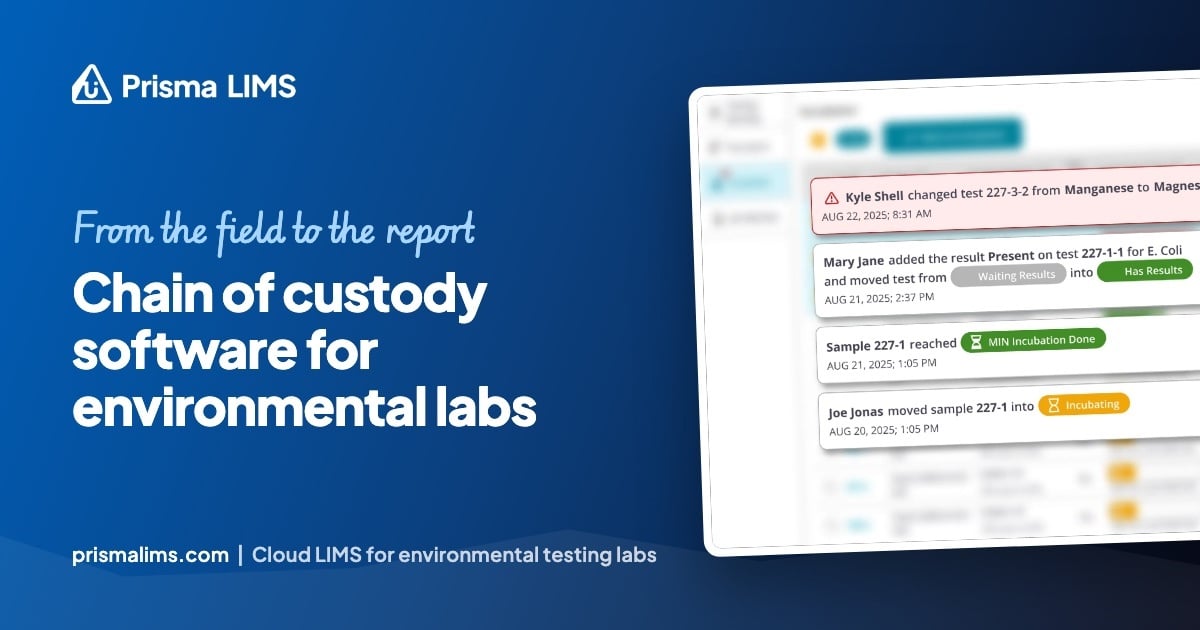
Accreditation belongs to the lab. Prisma LIMS keeps chain of custody and a full audit trail of who changed what and when.
Questions labs ask about COC forms
Who signs a chain of custody form?
Each person who hands the samples over and each person who takes them. EPA’s Sampler’s Guide says the former custodian signs off and the new custodian accepts each time custody changes hands.
Why does the collection time on the COC matter?
Under 40 CFR 136.3, the hold time for a grab sample begins at the time of collection. The lab needs that time to show each test started in time.
Looking at LIMS options for your lab? See how Prisma LIMS works as an environmental LIMS for water, wastewater and soil labs.
Sources (3)
We read each source below on 26 November 2026 and checked every claim in this post against it. Your state, your client or your QAPP may ask for more on the form.
- EPA: Sampler’s Guide, Contract Laboratory Program Guidance for Field Samplers (EPA 540-R-20-005, November 2020) (checked 26 November 2026). epa.gov
- 40 CFR 136.3: Identification of test procedures (Table II and footnote 4) (checked 26 November 2026). law.cornell.edu
- 40 CFR 141.33: Record maintenance (checked 26 November 2026). law.cornell.edu