
LIMS for commercial environmental labs
Thursday, 3 p.m.: sample control opens three coolers for three clients. One holds a utility’s monthly samples, one a consultant’s soil borings, one a homeowner’s well water. Each has its own hold times, its own report and, for the consultant, an EDD. This guide follows those samples from the bottle order to the client’s file. It is for owners, lab directors, QA managers, LIMS admins and project managers.
In short
A LIMS for a commercial environmental lab is software that keeps many clients’ samples, projects, reports and EDD files straight in one system. The lab tests for utilities, consultants, industry and homeowners. The LIMS also has to keep every hold time on track across all of them. Prisma LIMS is a cloud LIMS built only for environmental labs. Clients can view results in a read-only portal. We set up your reports and the client EDD files in your scope.
Why does a commercial lab need more from its LIMS?
Because its clients put its results in front of a regulator. Utilities send them to the state. Consultants put them in site reports. Industry checks them against a permit. Homeowners use them to decide about a well or a house.
Each client brings its own project, its own limits, its own report and often its own data file. The bench sees one queue. So the LIMS has to do both jobs: keep each client’s rules, and show the analyst what runs next.
TNI runs NELAP, the national program for accrediting environmental labs. Its stated mission is “the generation of environmental data of known and documented quality”. For a commercial lab, that record is the product.
What path does a sample take through a commercial lab?
In most commercial labs, the day runs in the same order. Each step hands a record to the next one.
Bottle order and COC
The client asks for bottles. The lab sends a kit with the right bottles, preservatives and a chain of custody (COC) form.
Receiving
Sample control opens the cooler. Staff check the temperature, the preservation and the COC against the bottles.
Login and the clock
Each sample is logged to its client, project and tests. Its hold-time clock started at collection.
Batches and QC
Samples go into prep batches and analytical batches. Each batch carries the QC its method asks for.
Review
A reviewer checks the results, the QC and any qualifiers before sign-out.
Report
The client gets a report. Some clients also need a full data package.
Client EDD
Many clients also want an EDD: a data file that loads into their own database or a state system.
What must a commercial lab LIMS handle at each step?
Seven jobs, in the order the sample meets them. Each ends with a question to ask any vendor.
Bottle orders and chain of custody
EPA says a chain of custody record “documents the exchange and transportation of samples from the field to the laboratory.” At each hand-off, the record “must be signed off by the former custodian and accepted by the new custodian”.
A commercial lab sends out kits for many clients every day. The COC that comes back has to match the bottle order, the client and the project. Any gap is a question that a client or an assessor will ask. See what chain of custody software must record.
What Prisma LIMS keeps for the assessor is in where Prisma LIMS fits, below.
Receiving and login
EPA’s SW-846 Chapter One lists sample custody among a lab’s written procedures. That covers receipt and handling, storage, security and tracking, and holding times.
At the receiving bench, that means the cooler temperature, the preservation check and any notes. Each one should stay with the sample from login on. Sample control staff log in coolers all day, so every extra screen adds up.
Hold times across every client
The clock starts at collection, not when the sample reaches the lab. Under the Clean Water Act table, coliform has 8 hours and BOD has 48 hours to the start of analysis. A drinking water coliform sample has 30 hours from collection to the start of incubation.
Some tests have two clocks. For pesticides in water, the same table gives 7 days until extraction and 40 days after extraction.
In a commercial lab, those clocks belong to many clients at once. The bench needs one view, sorted by time left. See common hold times and how a LIMS keeps the clock.
Prisma LIMS tracks each sample’s hold time from the collection time, shows the time left and warns you before it runs out. A sample can carry two clocks: one to extraction and one to analysis.
Prep batches, analytical batches and QC
Most tests run in batches. Each batch carries the QC its method asks for, such as a method blank, a lab control sample (LCS) and a matrix spike pair (MS/MSD). For Clean Water Act methods without their own QC steps, EPA lists twelve QC elements a lab must cover.
A commercial lab often puts samples from many clients in one batch. So the batch QC has to follow every sample in it, whichever client it belongs to.
Results mostly come from instrument files. Typing them in by hand is slow, and every typed number can hold a typo. We import the CSV files your instruments or data systems export, with a column map set up for your lab.
Review and sign-out
Before a result goes out, someone checks the QC, the hold time and any dilution. When something is off, the result gets a qualifier, such as a J-flag for an estimated value.
In a commercial lab, the reviewer is often also the person the client calls. A review queue that shows what is waiting, and why, saves time on both jobs.
Reports, data packages and client EDDs
Each client wants its results its own way. It may want a PDF report, a data package for a regulator, or an electronic data deliverable (EDD) that loads into its database. A rejected EDD comes back to the project manager, often after the report has gone out.
The safe way is one record per sample and many outputs from it. Then a fix made once shows up in the report and in the file. See which EDD formats labs send, and why EDDs get rejected.
Labs we talk to often say reporting is the heaviest part of their week: the reports, the data packages and the client EDDs.
Each EDD is built as setup work in your signed scope.
The client portal
Commercial labs get a steady stream of “is it in review yet?” calls. A portal lets the client check on its samples and pick up results without calling the lab.
Clients can view results in a read-only portal.
How does a LIMS keep many clients and projects straight?
It sets each client up once, so every new order picks up that client’s rules.
Many clients come back on a schedule: a utility’s monthly samples, a landfill’s quarterly wells, a plant’s permit tests. If each order is set up by hand, each order is a new chance for a mistake.
What a LIMS should hold for each client:
- Who gets the report, who gets the data file, and who gets the call when something goes wrong.
- Each project and sampling site, with its own tests.
- The recurring orders: the tests a client orders every month or every quarter.
- The permit or project limits that each result is compared against.
- The report format, the data package and the EDD the client expects.
We move your data from your old system. Every user is included. That matters in a lab where project managers, sample control, analysts and reviewers all touch the same sample.
How should a LIMS handle turnaround and rush work?
It should show the due date and the time left side by side, so neither one wins by accident.
Turnaround is part of what a commercial lab’s clients pay for. Many labs offer a standard turnaround and a faster rush option at a higher price.
Rush work and hold times pull the bench two ways. A rush job has a due date the client paid for. Every other sample still has a clock that runs from collection. A rush job should never quietly push another sample past its hold time.
Work sent to another lab needs the same care. Minnesota’s lab rule says records must allow “historical reconstruction of all laboratory activities that produced the analytical data.” That also applies to “interlaboratory transfers of samples or extracts”.
Questions to settle before you choose
- Where does the due date live: on the order, the sample or the test?
- Can the bench sort by due date and by time left at the same time?
- What happens to the report date when a sample is re-run?
- How are samples sent to a subcontract lab tracked, and how do their results come back?
- If you have more than one site, how do samples and results move between them?
Which matrices and methods must it cover?
All of the ones your clients send, in one system.
A full-service commercial lab rarely runs one matrix. The same week can bring drinking water, wastewater, groundwater, soil, sludge and waste. Each has its own methods, clocks and units.
Solids add their own math. Soil and sludge results are often reported on a dry weight basis. Some waste goes through a leaching test first. See what a soil and sludge lab needs from its LIMS and what a LIMS must track for TCLP and SPLP.
New programs add new methods. EPA lists Methods 533, 537.1 and 1633 for PFAS. See what your LIMS must handle for PFAS testing.
Methods running on Prisma LIMS today: EPA 524, 525 and 552, and THMs; EPA 200.7 and 200.8, and SW-846 6010 and 6020; total coliform and E. coli; BOD and TSS. PFAS: Methods 1633/1633A, 533 and 537.1 (analyte lists, batch QC, blanks).
Prisma LIMS supports dry-weight results with the reporting limit scaled, TCLP/SPLP leachate workflows, and metals from digestion batch to report.
How does a LIMS keep the data defensible?
It keeps every step and every change on record, with a name and a time.
Defensible data means anyone can follow a result back to where it came from. That includes the COC, the hold time, the batch and its QC, the analyst and every change.
State rules spell this out. Minnesota’s rule says “all changes must be clearly indicated in the records.” The lab must also record who made each change. Entries must not be hidden by “erasures, overwritten files, or markings”.
That is why shared logins are a risk. If several people share one account, the record can’t say who did what. See what to check in a LIMS for NELAP and TNI records.
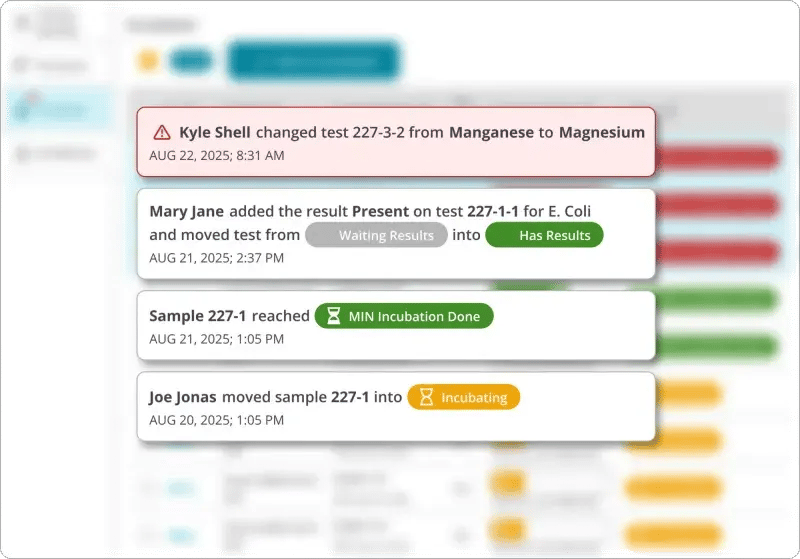
With Prisma LIMS you get a full audit trail, and an API for your team.
How do you move off an aging or acquired LIMS?
Plan the data move first, then test the new system next to the old one.
Many commercial labs run a system whose vendor was bought by another company. Others run one that only one person still knows how to fix. Either way, you have three choices: upgrade, move to the new owner’s product, or move to a different LIMS.
Whichever you choose, start with the data. Decide what history to bring, which client setups and report formats to rebuild, and how long you must keep the old records. Read our guide to planning a move off an acquired LIMS. If your vendor was bought, see our side-by-side page for labs on an acquired system, or how LIMS vendors for environmental labs compare.
We move your data from your old system. A sandbox where your team tests before go-live. On-site training and go-live support. See how you get live on Prisma LIMS, step by step.
Where Prisma LIMS fits, and where it does not
Prisma LIMS is a cloud LIMS for environmental testing labs in the US and Canada. We set it up for your lab, move your data, train your team, and run the hosting and support.
Environmental workflows: hold times, analytical and prep batches with QC, results review, reports, and the CMDP and EDD files in your setup.
Done-for-you means we do the work: we map your workflow, set up your methods and reports, move your data, test it with you in a sandbox, train your team on-site, and stay with you through go-live.
Accreditation belongs to the lab. Prisma LIMS keeps chain of custody and a full audit trail of who changed what and when.
The people who build it are the people you talk to, from the first call to support after go-live. While we built Prisma LIMS, we talked with more than a dozen labs to check our workflows and designs. Everything we build comes from the needs and feedback of labs doing the work, and it still does.
Every client gets a shared Slack channel with us. We usually reply within 2 hours and fix most bugs within 48 hours.
Prisma LIMS runs in the cloud on AWS, with a PostgreSQL database. We handle updates, fixes and security. We back up your data, and we export it for you on request.
Built for
Prisma LIMS is built only for environmental labs: mid-sized and large commercial, municipal and utility labs that test water, wastewater, drinking water, soil and sludge, in the US and Canada. Other environmental matrices are on request.
Not a fit for
Prisma LIMS is not a fit for clinical-only or pharma-only labs, very small labs, or labs that prefer to build and run their own system.
What it costs
Setup is a one-time fee. After go-live there is one monthly fee that covers hosting, updates, support and every user. We give you a range on our first call and a written quote for your lab.
How you get live
You get a test system loaded with your own data in about 90 days. You run it next to your current process for an agreed side-by-side period, then we go live on your sign-off. Dates depend on how fast your team gives us methods and data.
Every client gets results it can defend
When each sample keeps its COC, its clock, its batch QC and its history in one record, every report and file comes from the same data. That is what a commercial lab sells.
Questions commercial labs ask
What is a commercial environmental lab?
A commercial environmental lab is a private lab that tests water, soil and waste samples for paying clients. Its clients include utilities, consultants, industry, government and homeowners. It holds its own accreditation, and it sends each client a report and often a data file. It is also called a contract lab.
What does a commercial environmental lab need from a LIMS?
It needs to keep many clients straight at once: their projects, limits, reports and EDD files. It also needs hold-time clocks across every job, batch QC, an audit trail and instrument file import. And clients need a way to see results without calling. Test any system on your own clients’ files.
What is a contract lab LIMS?
A contract lab LIMS is set up around clients. Each sample belongs to a client and a project. Each client gets its own report, its own data file and its own view of its results. The bench still sees one queue, sorted by what has to run next.
How does a lab send results in each client’s EDD format?
The safe way is to build each EDD from the same results as the report, so a fix made once shows up in both. The layout comes from the client or the state. We set up your reports and the client EDD files in your scope. Ask each vendor which formats it builds and how it checks the file. See our guide to EDD formats.
Can clients see their results online?
With many LIMS, yes, through a client portal. Ask each vendor what clients can see and what they can change. With Prisma LIMS, clients can view results in a read-only portal.
How do you keep rush work from breaking hold times?
Sort the bench by due date and by time left together. A rush job has a due date the client paid for. Every other sample still has a clock that runs from collection. When both show in one view, a rush job does not quietly push another sample past its hold time.
Keep reading
-
Environmental LIMS guide
A wrong choice costs years. This guide lists what to check in any system, and the questions to ask every vendor.
How to choose an environmental LIMS -
EDD formats
Each client and state wants its own file. See the common formats, and why EDDs get rejected.
EDD formats: a guide for environmental labs -
Chain of custody
Every hand-off, from the field to the report. See what the record must hold.
Chain of custody software for environmental labs -
City and utility labs
Run a lab for a city, a utility or a treatment plant? See what your LIMS must handle.
LIMS for municipal and utility labs -
LIMS cost
The quote is one part of the bill. Add up five years with your own numbers.
LIMS pricing and the five-year cost
Last checked: 26 November 2026. Next check due: 26 May 2027.
Schedule an online demo
The first call is a 30-minute Lab Systems Diagnostic. Then we show Prisma LIMS on your own files.
Schedule an online demo