
NELAP and TNI records: what to check in a LIMS
A LIMS for a TNI lab has to keep the records an assessor uses to rebuild a result. On day one of an on-site assessment, the assessor picks a result from last spring. Then come the questions: where is its COC, did it meet its hold time, what QC ran with it, and who changed it? This guide is for lab directors and QA managers at labs accredited to the TNI Standard. It explains the terms, who accredits whom, which records state rules ask for, and what to check in a LIMS.
In short
NELAP is the National Environmental Laboratory Accreditation Program of The NELAC Institute (TNI). Under NELAP, state agencies accredit labs to the TNI Standard. Four private bodies that TNI recognizes also accredit labs to it. The state rules built on it ask a lab to keep records that let an assessor rebuild how each result was made: samples, custody, QC, changes and corrective actions. A LIMS keeps those records. Accreditation belongs to the lab.
What are NELAC, NELAP and TNI?
The names sound alike, and people mix them up. Here is what each one means.
- NELAC is the National Environmental Laboratory Accreditation Conference. EPA’s lab advisory board traces the national accreditation process and standards back to it. Many people still say “NELAC” when they mean the standard.
- TNI is The NELAC Institute, “a 501(c)(3) non-profit organization.” Its mission is “the generation of environmental data of known and documented quality”. TNI writes the standard by consensus.
- NELAP is the National Environmental Laboratory Accreditation Program. TNI runs it “for the accreditation of environmental laboratories”.
- The TNI Standard is the set of rules a lab is assessed against. New Hampshire and Virginia, for example, use the 2016 edition. TNI sells it; it is not free to read.
How the TNI Standard is laid out
Volume 1 covers labs. Volume 2 covers the bodies that accredit them. Volume 1 has seven modules:
| Module | What it covers |
|---|---|
| Module 1 | Proficiency testing |
| Module 2 | Quality systems: the general rules for every lab, including records |
| Modules 3 to 7 | Quality systems for asbestos, chemical, microbiological, radiochemical and toxicity testing |
Most of the record rules that touch a LIMS sit in Volume 1, Module 2. People call it “V1M2”.
Who accredits a NELAP lab?
TNI does not accredit labs itself. Accreditation bodies do. TNI lists 14 state agencies as NELAP-recognized accreditation bodies:
- Florida Department of Health
- Illinois Environmental Protection Agency
- Kansas Department of Health & Environment
- Louisiana Department of Environmental Quality
- Minnesota Department of Health
- New Hampshire Department of Environmental Services
- New Jersey Department of Environmental Protection
- New York State Department of Health
- Oklahoma Department of Environmental Quality
- Oregon Health Authority
- Pennsylvania Department of Environmental Protection
- Texas Commission on Environmental Quality
- Utah Department of Health and Human Services
- Virginia Department of General Services
Is your lab in one of those states? Then TNI says “you must go to that state for accreditation.” A lab in any other state or country can apply to any NELAP body, or to a non-governmental body.
TNI recognizes four non-governmental bodies: the ANSI National Accreditation Board (ANAB), the American Association for Laboratory Accreditation (A2LA), the International Accreditation Service (IAS) and Perry Johnson Laboratory Accreditation (PJLA). TNI, not NELAP, recognizes them, and they accredit labs to the TNI Standard. TNI also notes that “some states will not accept accreditations from NGABs”. Ask your state and your clients first.
One body is your primary. Others can accept its work. Each NELAP body “will accept by recognition, the accreditation status of a laboratory issued by another NELAP Accreditation Body.” TNI calls this secondary accreditation.
Drinking water is its own track. State certification for drinking water and NELAP accreditation are not the same thing. See what a certified drinking water lab needs.
What records do New Hampshire and Minnesota require?
Both rules ask for records that show how each result was made. Minnesota calls it “historical reconstruction.” That covers sample receipt, custody and prep, and QC results and limits. It covers who did each task, and every change, with the old entry still visible. It also covers corrective actions, and standards and equipment records. Minnesota asks for at least five years after the last entry, unless a permit, program or rule asks for longer.
The standard is sold, so we point to two state rules that build on it. New Hampshire’s rule sends labs to the right section of Volume 1, Module 2 for each topic. Minnesota’s rule spells out its records rule in plain words.
| Record | What the rule asks | Source |
|---|---|---|
| The whole story of a result | The records “must allow historical reconstruction of all laboratory activities that produced the analytical data,” including samples sent to another lab. | Minn. R. 4740.2097 A |
| Sample handling and custody | Meet the sample collection, handling and preservation rules in V1M2 sections 5.7 and 5.8. Sample receipt and prep must be documented. | NH Env-C 305.08; Minn. R. 4740.2097 D |
| Records and reports | Meet the records and reporting rules in V1M2 sections 4.13 and 5.10. Every QC and sample result carries its unit. | NH Env-C 305.11 |
| Quality control | Monitor QC as in V1M2 section 5.9. Use the lab’s written QC limits to decide if data can be used. | NH Env-C 308.06 |
| Corrective action | Write down each departure and its fix: the root cause, the action, the follow-up and a signed, dated approval. Samples tied to failed QC are reported with qualifiers. | NH Env-C 308.05 |
| Data integrity | Run data integrity investigations as in V1M2 section 4.16. Keep procedures that protect “the integrity and security of the data.” | NH Env-C 308.01; Minn. R. 4740.2097 I |
| Changes and corrections | Show every change clearly, and who made it. No erasures, “overwritten files” or markings that hide the old entry. | Minn. R. 4740.2097 F, H |
| Who did the work | Name the person responsible for each task, and keep a record of each person’s signature and initials. | Minn. R. 4740.2097 C |
| Standards and equipment | Reference standards meet the traceability rules in V1M2 section 5.6. Equipment and calibration follow section 5.5. | NH Env-C 305.06 |
| Proficiency testing | Keep PT records for 5 years, or longer if a program asks: bench sheets, instrument printouts, calculations and reports. | NH Env-C 307.07 |
| How long to keep it | At least five years after the last entry, unless a permit, program or rule asks for longer. For electronic-only records, keep the hardware and software to read them for the same time. | Minn. R. 4740.2097 B |
Your own accreditation body may word these differently, or set other periods. Read its rule, and ask it which edition of the TNI Standard it uses.
Two of these records start in the field. The chain of custody and the collection time drive everything after them. See chain of custody software and sample holding times.
What should you check in a LIMS for TNI accreditation?
No LIMS makes a lab accredited. But a good one makes the records easy to keep and hard to lose. Labs we talk to often say audit prep is where the gaps in their records show up. Check these on your own data.
- Rebuild one old result. Pick a sample from last year and trace it from receipt to the report: custody, prep batch, run, QC, review and release.
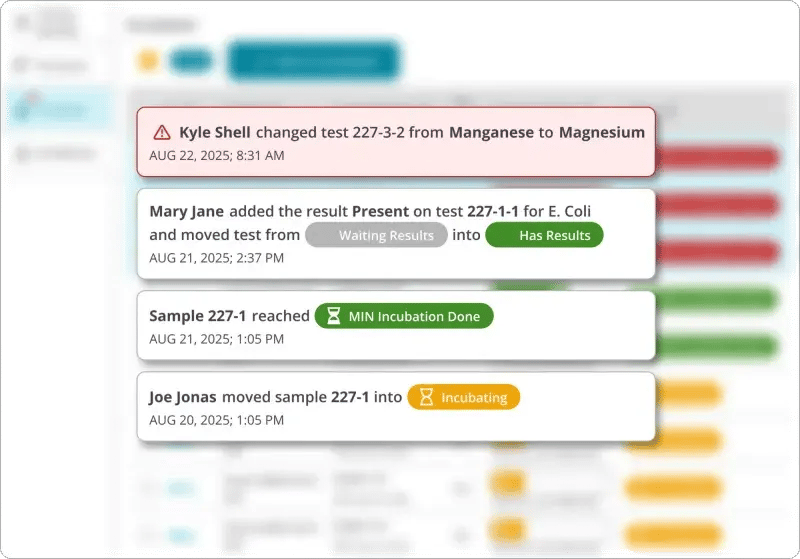
- The audit trail covers what matters (results, sample IDs, collection times and limits), and each change keeps the old value, the new value, who and when.
- There is no way around it. Ask who can edit a released result, and whether anyone can turn the audit trail off.
- Hold-time clocks start at collection, with a warning before time runs out.
- Blanks, spikes and duplicates are linked to their samples and checked against your limits.
- When QC fails, the qualifier follows the data all the way to the report.
- Each person has one login. With no shared accounts, every record names a real person.
- Years later, you can still pull up everything for one method, client or date range.
How do assessors look at LIMS records?
An assessor checks a lab by “examining the records and other physical evidence” for each test on its scope. That is New Hampshire’s definition. In practice, a lot of those records live in the LIMS.
How often? New Hampshire assesses each of its labs “at least once every 18 to 30 months.” It can also make an extra visit after a complaint. That visit is unannounced “if laboratory records could be destroyed or altered if prior notice is given”. Other states set their own timing.
Be ready to:
- Trace a reported result back to the sample, the batch, the QC and the analyst.
- Show the history of a change: what it was, what it became, who changed it and when.
- Show a corrective action, from the failed QC to the signed approval.
- Pull PT records and the bench data behind them.
- Hand over records on request. Minnesota gives labs 30 days to supply what the commissioner asks for.
How Prisma LIMS keeps the record
Prisma LIMS is a cloud LIMS for environmental testing labs in the US and Canada. We set it up for your lab, move your data, train your team, and run the hosting and support.
Accreditation belongs to the lab. Prisma LIMS keeps chain of custody and a full audit trail of who changed what and when.
Prisma LIMS tracks each sample’s hold time from the collection time, shows the time left and warns you before it runs out. One sample can carry two clocks: one to extraction and one to analysis.
Prisma LIMS runs analytical and prep batches with their QC, with warnings on both. With Prisma LIMS you get a full audit trail, and an API for your team.
Done-for-you means we do the work: we map your workflow, set up your methods and reports, move your data, test it with you in a sandbox, train your team on-site, and stay with you through go-live. See how you get live on Prisma LIMS.
Ask us to show the audit trail on your own samples and files.
Where Prisma LIMS fits, and where it does not
Built for
Prisma LIMS is built only for environmental labs: mid-sized and large commercial, municipal and utility labs that test water, wastewater, drinking water, soil and sludge, in the US and Canada. Other environmental matrices are on request.
Methods running on Prisma LIMS today: EPA 524, 525 and 552, and THMs; EPA 200.7 and 200.8, and SW-846 6010 and 6020; total coliform and E. coli; BOD and TSS.
Not a fit for
Prisma LIMS is not a fit for clinical-only or pharma-only labs, very small labs, or labs that prefer to build and run their own system.
Questions labs ask about NELAP and TNI
What does NELAP stand for?
NELAP stands for the National Environmental Laboratory Accreditation Program. It is a program of The NELAC Institute (TNI). State agencies serve as its accreditation bodies.
What is the difference between NELAC and NELAP?
NELAC was the National Environmental Laboratory Accreditation Conference, where the national process and standards began. NELAP is the accreditation program that TNI runs today. People often say “NELAC accredited” when they mean NELAP.
What is the TNI Standard?
The TNI Standard is the set of rules TNI writes for environmental labs and the bodies that accredit them. Volume 1 is for labs, and its Module 2 holds the general quality system rules, including records. New Hampshire and Virginia, for example, use the 2016 edition.
Does a LIMS make a lab NELAP accredited?
No. The lab earns accreditation, and an accreditation body grants it after an assessment. A LIMS helps the lab keep the records the assessor checks. For what Prisma LIMS keeps, see how Prisma LIMS keeps the record.
Is accreditation from a non-governmental body the same as NELAP accreditation?
Not quite. NELAP accreditation bodies are state agencies. TNI also recognizes four non-governmental bodies, such as A2LA and ANAB, that accredit labs to the same TNI Standard. TNI notes that some states will not accept their accreditation. So check with your state, and with the clients you report to, before you choose a body.
Is there a TNI-approved LIMS?
Not that we found. TNI’s programs accredit labs through accreditation bodies and write standards. We found no TNI program that approves LIMS software. Treat “TNI LIMS” as a LIMS that helps a lab keep TNI records.
How long must a lab accredited to the TNI Standard keep records?
Check your own accreditation body. Minnesota asks for at least five years after the last entry, unless a permit, program or rule asks for longer. New Hampshire asks for 5 years for PT records.
Keep reading
-
Chain of custody
What the record must hold, from the bottle order to the report, and what to ask any vendor.
Chain of custody software -
Sample holding times
The clock starts at collection. See common EPA hold times and how a LIMS warns you in time.
Sample holding times explained -
Environmental LIMS guide
What any system must handle for a water, wastewater or soil lab, and the questions to ask every vendor.
Environmental LIMS: how to compare systems -
LIMS cost
What five years really cost: setup, data moves, training, upkeep and the time your staff gives.
LIMS cost: what five years really cost -
Drinking water labs
State certification is not the same as NELAP. See what a certified drinking water lab needs.
Drinking water LIMS guide -
Cloud LIMS
What a cloud LIMS is, who runs what, and how to judge one for an accredited lab.
Cloud LIMS for environmental labs
Last checked: 26 November 2026. Next check due: 26 May 2027.
Schedule an online demo
The first call is a 30-minute Lab Systems Diagnostic. Then we show Prisma LIMS on your own files.
Schedule an online demo