
Wastewater LIMS: what a wastewater lab needs from its software
A wastewater LIMS is software that tracks a wastewater lab’s samples, hold times, batches with QC and results, and builds the reports the lab sends for its permit. It is the last week of the month. The DMR goes out on Friday, and one effluent ammonia result still sits on a bench sheet nobody has typed in. This plain guide is for lab managers and utility lab directors. It covers permit reports, hold times, batches with QC, instrument files and client work, with the questions to ask any vendor.
In short
A wastewater LIMS is software that tracks a wastewater lab’s samples, hold times, batches with QC and results. It also builds the reports the lab sends for its permit. Ask any vendor to show each of those on your own methods and your own report. Prisma LIMS is a cloud LIMS built only for environmental labs, and we set it up for your lab.
Why the monthly report can’t be late
A plant that discharges to a river or a lake needs a National Pollutant Discharge Elimination System (NPDES) permit under the Clean Water Act. The permit sets limits on what it may discharge. It also sets what to sample and how to report it.
Large plants with a steady discharge usually report every month. Smaller ones may report less often.
Now say a bacteria sample misses its hold time. The result can’t be used, so the plant has to sample again. The report can be late, and the lab is the first to hear about it.
What a wastewater lab does all day
A wastewater testing laboratory follows the water through the plant, and the solids too.
- Influent tests show what comes into the plant.
- Process control tests help the operators run the plant from day to day.
- Effluent tests check what leaves the plant against the permit limits.
- Sludge and biosolids get solids tests, often reported on a dry weight basis.
- The lab’s results go on the discharge monitoring report (DMR) and other permit reports. Some labs also report to outside clients.
What is a DMR?
A DMR is how a permit holder reports its own test results. The federal rule, 40 CFR 122.2, calls it “the EPA uniform national form” for “the reporting of self-monitoring results by permittees.”
What a wastewater LIMS must handle
Five jobs. Each ends with a question to ask any vendor.
Permit reporting: DMRs and NetDMR
NPDES permittees must send their DMRs electronically. States may use EPA’s tool, called NetDMR, or build their own.
So each result has to land in the right DMR field, for the right outfall and the right period. A LIMS should keep each result with its permit parameter, its units and its limit. Nobody should retype it from a printout. Labs we talk to often say a single result gets typed more than once before it reaches the DMR.
Hold times that can’t wait
The limit depends on the program your sample is for. These seven come from the Clean Water Act table. The clock runs from collection to the start of analysis.
| Test | Program | Maximum holding time |
|---|---|---|
| Coliform (total, fecal, E. coli) | Clean Water Act (40 CFR 136.3) | 8 hours |
| Biochemical oxygen demand (BOD) | Clean Water Act (40 CFR 136.3) | 48 hours |
| Total suspended solids (TSS) | Clean Water Act (40 CFR 136.3) | 7 days |
| Ammonia | Clean Water Act (40 CFR 136.3) | 28 days |
| Phosphorus, total | Clean Water Act (40 CFR 136.3) | 28 days |
| pH | Clean Water Act (40 CFR 136.3) | Analyze within 15 minutes |
| Metals (except boron, chromium VI and mercury) | Clean Water Act (40 CFR 136.3) | 6 months |
Drinking water samples follow different rules. See what a drinking water LIMS must track. For more tests and the two-clock rule, see the coliform row in our holding times table and the BOD row.
Batches, QC sets and dry weight for solids and sludge
Most tests run in batches. Each batch carries the QC its method asks for, such as a method blank, a lab control sample, a matrix spike and a duplicate. For Clean Water Act methods that lack their own QC steps, EPA lists twelve QC elements a lab must cover (40 CFR 136.7).
Sludge and biosolids results are often reported on a dry weight basis. So the system needs the percent solids for each sample, and it must do the math the same way every time. Some sludge also goes to a leaching test: see what a LIMS must track for TCLP and SPLP.
Instruments and the files they write
Analyzers, ion chromatographs and ICPs (for metals by EPA Method 200.7 or 200.8) write results files. Typing them in by hand is slow, and every typed number can hold a typo. A LIMS should read the file, match each row to the right sample, and keep a record of the load.
Clients, bottle orders and COCs
Many wastewater labs also test for outside clients, such as industrial users and nearby towns. Each client needs bottles, a chain of custody and a report.
Bottle orders, pre-login and printed labels cut errors before the sample even arrives. Every hand-off after that belongs on record. See what chain of custody software must record.
Where Prisma LIMS fits, and where it does not
Prisma LIMS is a cloud LIMS for environmental testing labs in the US and Canada. We set it up for your lab, move your data, train your team, and run the hosting and support.
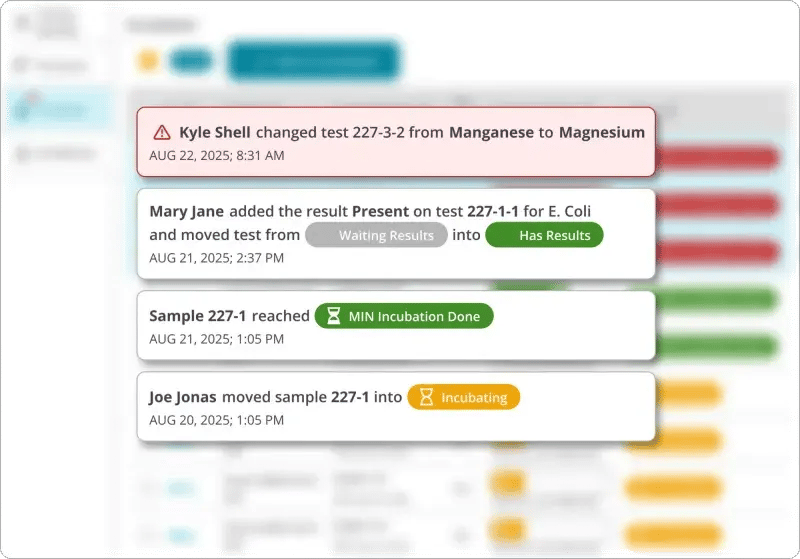
- Prisma LIMS supports wastewater lab workflows: hold-time tracking and batches with QC.
- Prisma LIMS builds DMR values and netDMR files from your results.
- Sludge results can be reported on a dry weight basis, with the reporting limit scaled.
- We import the CSV files your instruments or data systems export, with a column map set up for your lab.
- Clients can view results in a read-only portal. We set up your reports and the client EDD files in your scope.
- Done-for-you means we do the work: we map your workflow, set up your methods and reports, move your data, test it with you in a sandbox, train your team on-site, and stay with you through go-live.
- Every client gets a shared Slack channel with us. We usually reply within 2 hours and fix most bugs within 48 hours.
- Methods running on Prisma LIMS today: EPA 524, 525 and 552, and THMs; EPA 200.7 and 200.8, and SW-846 6010 and 6020; total coliform and E. coli; BOD and TSS.
- Accreditation belongs to the lab. Prisma LIMS keeps chain of custody and a full audit trail of who changed what and when.
Built for
Prisma LIMS is built only for environmental labs: mid-sized and large commercial, municipal and utility labs that test water, wastewater, drinking water, soil and sludge, in the US and Canada. Other environmental matrices are on request.
Not a fit for
Prisma LIMS is not a fit for clinical-only or pharma-only labs, very small labs, or labs that prefer to build and run their own system.
What it costs
Setup is a one-time fee. After go-live there is one monthly fee that covers hosting, updates, support and every user. We give you a range on our first call and a written quote for your lab.
How you get live
You get a test system loaded with your own data in about 90 days. You run it next to your current process for an agreed side-by-side period, then we go live on your sign-off. Dates depend on how fast your team gives us methods and data.
The monthly report goes out on time, from data you trust
When every sample has its clock, its batch and its QC in one place, the report is built from results you can trace. Fewer missed hold times mean fewer resamples and fewer late reports.
Ask us to show it on your own methods and files.
Questions wastewater labs ask
What do wastewater labs do?
Wastewater labs test the water coming into and leaving a treatment plant, plus the solids. They run process control tests for the operators, check effluent against the permit, and report the results on the DMR.
Which wastewater results go on the DMR?
The results your NPDES permit asks for, for each parameter, outfall and period, plus the values the permit asks you to work out from them. If you test a permitted pollutant more often than the permit asks, those results go into the DMR calculations and reporting too. That applies when the testing uses procedures approved under 40 CFR Part 136 or set in the permit.
What tests does a wastewater lab run?
The permit decides, but common wastewater lab tests include BOD, total suspended solids (TSS), ammonia, total phosphorus, pH and bacteria such as E. coli. Each of these is a listed test in 40 CFR 136.3, with hold times from 15 minutes for pH to 28 days for ammonia and total phosphorus. Sludge and biosolids add solids tests.
What should wastewater compliance software do?
It should keep every result tied to its sample, its hold time, its batch QC and its permit limit. Then it should help you build the DMR without retyping. Accreditation and the permit stay with the lab and the plant; the software keeps the record.
What is DMR reporting software?
DMR reporting software builds the discharge monitoring report from the lab’s own results. Each value lands in the right DMR field, for the right outfall and the right period, with no retyping. Ask any vendor to build last month’s DMR values from your own results. For how NetDMR and state eDMR systems take the report, see NetDMR and DMR reporting.
What LIMS should a wastewater lab use?
One that ties every result to its sample, hold time, batch QC and permit limit, and builds the DMR without retyping. Ask each vendor to show it on your own methods. Prisma LIMS supports wastewater lab workflows: hold-time tracking, batches with QC, and DMR and netDMR files. The rest of our part is under where Prisma LIMS fits.
Keep reading
-
Environmental LIMS guide
A wrong choice costs years. This guide lists what to check in any system. It ends with the questions to ask every vendor.
How to choose an environmental LIMS -
Sample holding times
One missed clock costs a resample. See common EPA hold times with sources. Learn how a LIMS keeps the clock.
Sample holding times and how a LIMS tracks them DMR reporting
Each permit result lands on the DMR. See how NetDMR and state eDMR systems work, and what to check in software.
NetDMR and DMR reporting guideLIMS cost
The quote is one part of the bill. See how LIMS pricing works, and add up five years with your own numbers.
LIMS pricing and the five-year costPFAS testing
Method 1633A (40 PFAS) can show up in a wastewater permit. See which EPA method fits which sample. Learn what a LIMS must hold.
PFAS testing and Method 1633A
Last checked: 24 and 26 November 2026. Next check due: 24 May 2027.
Schedule an online demo
The first call is a 30-minute Lab Systems Diagnostic. Then we show Prisma LIMS on your own files.
Schedule an online demo